From Meiji government prison to hoshinoya nara prison hotel japan luxury landmark
Hoshinoya Nara Prison is Japan’s first full conversion of an entire correctional facility into a luxury hotel, and it treats the past as a cohost rather than a backdrop. The former Nara Prison complex in Nara Prefecture, completed under the Meiji government in 1908 and now designated as a nationally registered cultural property, has been reimagined by Hoshino Resorts as a 48-suite retreat where every corridor still reads like a chapter of land history and history culture.[1] For travellers used to anonymous five-star towers, this adaptive reuse project feels almost radical in its restraint.
The original Nara Prison was designed by architect Keijiro Yamashita, one of the key figures of the Meiji era, and it remains the only fully intact survivor among Japan’s so-called Five Great Prisons.[2] Its iconic red brick walls, radiating cell wings and watchtowers have been preserved as historic walls rather than prettified props, so the property wears its past openly and the brick walls still frame every approach to the rooms and suites. The result is a prison-turned-hotel that now ranks among Japan’s most intriguing luxury addresses, where the walk from gate to lobby is as choreographed as any spa ritual, but the choreography is architectural rather than theatrical.
Hoshino Resorts, the brand behind Hoshinoya Kyoto, the coastal KAI hot spring resorts and the urban OMO hotels, operates this property in partnership with Former Nara Prison Preservation and Utilization Co., Ltd., the entity responsible for safeguarding the site.[3] That ownership structure matters, because prison preservation is not a side story here; it is the business model, with tourism revenue underwriting the long-term care of the cultural property and its red brick fabric. For a discerning guest, that means every stay at Hoshinoya Nara becomes part of a broader japan luxury experiment in how high-end travel can fund conservation rather than erode it.
The hotel will open on a roughly 25-acre site at 18 Hannyaji-cho in Nara City, placing guests within easy reach of Todai-ji, Nara Park and the quieter temple districts that reward slow walkers.[1] Within the compound, the story of this Meiji-era prison hotel is carried by the preserved brick walls, the radial plan and the disciplined use of materials, not by themed props or novelty uniforms. You feel the prison in the long corridors and heavy doors, but you feel the luxury in the silence, the proportions and the way staff manage to make a former jail feel like a private ryokan without erasing its history culture.
Suites from cells: how design turns confinement into an immersive stay
Designer Rie Azuma’s brief was deceptively simple: keep the prison, add comfort, avoid kitsch.[1] Her response was to treat each wing of the Nara Prison as a spine and to carve suites from clusters of nine to eleven former cells, creating distinct themes in the way sleeping, dining and relaxation zones are arranged within the historic walls. She has said that “the space already possessed a sense of extraordinary experience” — enhancement rather than transformation — and that philosophy shows in the way the original brick walls and steelwork remain visible in many rooms.
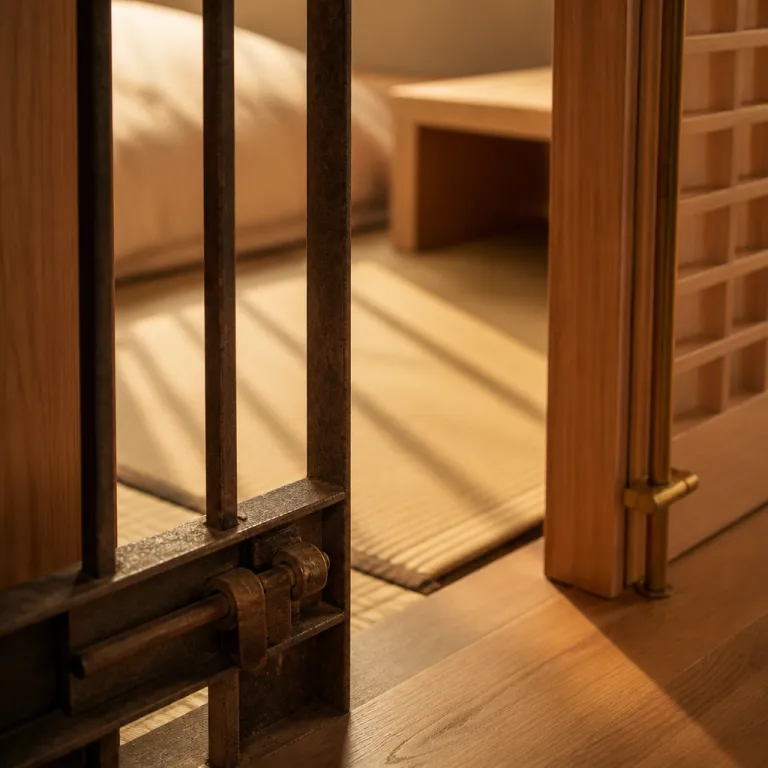
Instead of erasing the iconic red masonry, the design leans into it, using the red brick and the rhythmic windows as the primary decorative language of this luxury hotel. In some suites, the old cell doors are retained as sculptural elements, while new timber and washi soften the lines without pretending that the property was anything other than a prison for most of its life. The result is an immersive stay where the Meiji era architecture is not a costume but a structure, and where the Hoshinoya and Hoshino names are attached to a project that feels more like a cultural institution than a standard hotel.
Across the 48 rooms, layouts vary subtly, but the logic is consistent: long, narrow former cells become meditative corridors, while cross walls are opened to create generous living spaces that still respect the original grid.[1] Some suites frame internal courtyards, others look towards the outer brick walls, and all are designed to keep guests aware that they are inside a former prison without ever feeling confined. For Indian travellers used to palace conversions in Rajasthan, this is closer in spirit to a carefully restored haveli than to a theme park, and it invites the same kind of slow, attentive stay that rewards repeat visits.
Hoshino Resorts positions Hoshinoya Nara alongside its KAI hot spring properties and its urban OMO brand, but this project pushes the portfolio into new territory where hospitality, museum practice and heritage policy intersect. The operator is explicit about its objectives: “Preserve historical architecture”, “Offer unique luxury experience”, “Promote cultural heritage”, and those aims are legible in every design decision, from the restrained palette to the absence of gimmicky prison keys on room cards.[3] If you are tracking how global luxury brands handle heritage, it is worth reading this against other adaptive reuse projects, from the Langham Bangkok customs house conversion to the Waldorf Astoria Jaipur pool villa estate, which is analysed in depth in this piece on Hilton’s luxury debut in Rajasthan at what Hilton’s luxury debut means for Rajasthan.
Prison museum, cultural programming and what this means for heritage luxury
The most radical move at Hoshinoya Nara is not the suites; it is the on-site prison museum that sits at the heart of the compound. The Nara Prison Museum is open to day visitors, but hotel guests receive exclusive access windows from 6:00 to 8:30 and 18:00 to 23:00, turning a simple walk through the galleries into a private, almost contemplative experience.[2] This is where the full history culture of the Nara Prison, from its Meiji era origins under the Meiji government to its later role in Nara Prefecture, is laid out with a candour that many luxury projects would shy away from.
For travellers used to heritage hotels that gloss over uncomfortable pasts, the frankness is refreshing, because the prison preservation narrative is not tucked away in a brochure but embedded in the daily rhythm of a stay. You can spend the morning in the museum, tracing the land history of the site and the evolution of Japan’s penal system, and the evening in a suite that uses the same brick walls as a backdrop for a kaiseki dinner. It is a model where tourism directly funds cultural preservation, and it suggests a path forward for other japan luxury projects that want to move beyond surface-level storytelling.
Within the wider Hoshino Resorts ecosystem, which ranges from rural KAI hot spring resorts to urban OMO hotels, Hoshinoya Nara stands out as a test case for how a brand can handle difficult heritage without diluting luxury. The operator’s own FAQ is blunt: “What is Hoshinoya Nara Prison?” — “A luxury hotel converted from a Meiji era prison.”; “When does Hoshinoya Nara Prison open?” — “June 25, 2026.”; “Where is Hoshinoya Nara Prison located?” — “Nara City, Nara Prefecture, Japan.” That clarity, combined with the decision to keep the prison museum active, makes this property feel closer to a living cultural property than to a static resort.[1]
For Indian guests who already split their calendar between palace stays in Udaipur, monsoon hideaways in Goa and urban flagships in Tokyo, the proposition here sits in a different mental drawer. It belongs in the same conversation as adaptive reuse icons, and it rewards the same kind of research-driven planning you might apply when choosing between the quieter lake-facing suites in Udaipur, as unpacked in this analysis of under-the-radar palace wings at what the best luxury hotels in Udaipur leave out. If you care about where your money goes, this is one of the rare japan luxury addresses where every night’s rate supports the upkeep of iconic red brick, the conservation of historic walls and the continuation of a story that began as a prison and now reads as a case study in deliberate, grown-up luxury.
For those mapping a broader circuit of heritage-led stays, it is worth pairing Nara with quieter cultural stops, whether that means a ryokan in the Kansai hills or a monsoon season coastal retreat that values mood over sunshine, such as the properties examined in this guide to luxury hotels in Goa during the monsoon. The through line is the same; the best luxury is not about spectacle but about how carefully a place is held, whether that place is a former jail in Nara or a rain-soaked cliff in the Konkan. In that sense, Hoshinoya Nara is less a novelty and more a manifesto, proving that the future of five-star travel lies not in ever larger lobbies but in ever deeper respect for the walls that were here before us.
Sources
[1] Hoshino Resorts official news releases on Hoshinoya Nara Prison (opening date June 25, 2026; site area; suite count; design concept; guest access details).
[2] Japan Agency for Cultural Affairs records on Former Nara Prison (architect Keijiro Yamashita; Five Great Prisons; cultural property designation; museum outline).
[3] Former Nara Prison Preservation and Utilization Co., Ltd. documentation (preservation framework; operating structure; stated objectives for the redevelopment).